Education
What Is 24-Hour Stock Trading, and How Does It Work?
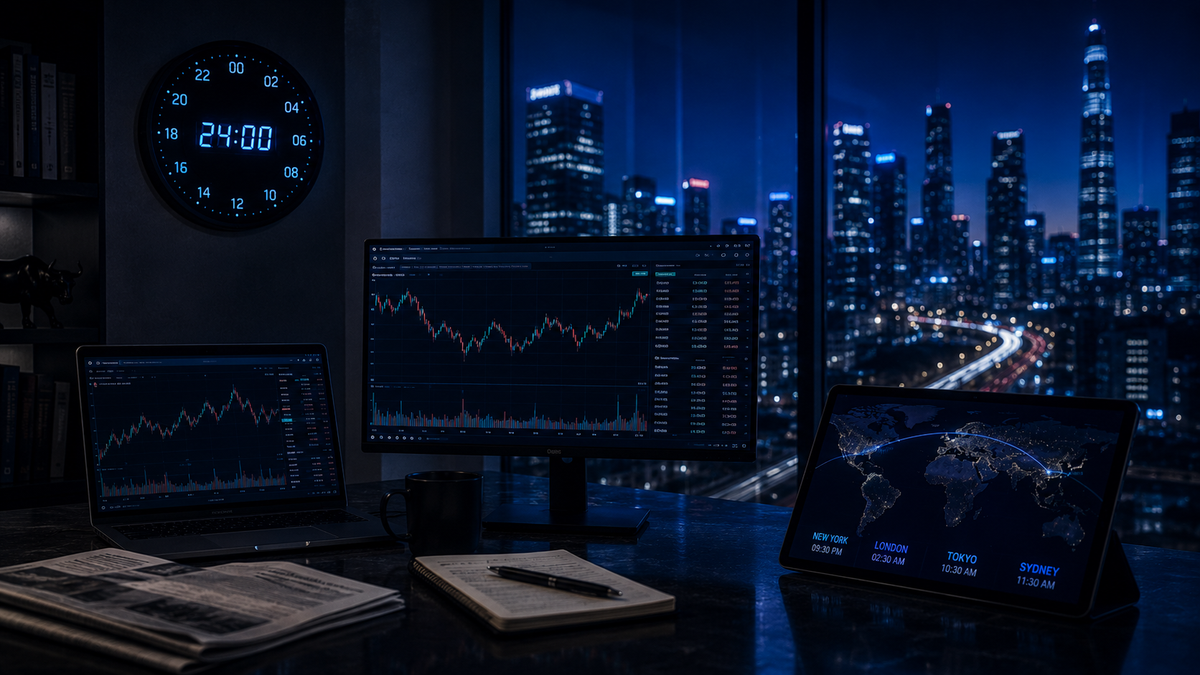
24-hour stock trading means trading outside the 9:30am–4pm ET session — via extended hours, overnight venues, and stock perps that quote around the clock.
TL;DR: Traditional stock markets trade for about six and a half hours on weekdays — a holdover from a pre-electronic era. Extended-hours sessions, overnight electronic communication networks, and perpetual futures on single-name stocks have already pushed retail access well beyond that window. Full 24-hour and weekend coverage is rolling out unevenly across exchanges and platforms. For the trader, the practical effect is that price-moving news no longer waits for the opening bell — and the instruments to trade through that news are increasingly available.
Where traditional stock market hours came from
The standard 9:30 AM to 4:00 PM ET trading window on traditional US equity exchanges — or the equivalent windows on other major exchanges globally — dates from an era when stock exchanges were physical floors. Traders met in person, matched orders by voice and hand signal, and went home at the end of the day. The market closed because the people stopped working.
Electronic order matching ended that physical constraint in the 1990s and 2000s, but the exchange hours did not change. The window became an institutional habit, supported by clearing-and-settlement infrastructure that had built up around the same hours. Brokers, clearinghouses, market makers, and index calculators all assumed a daily close. Moving off that schedule meant rebuilding parts of the infrastructure.
Modern exchanges run electronically. The constraint that originally produced the six-and-a-half-hour window is gone, but the structures built around it remained for decades after the floor closed.
Why exchanges are pushing toward longer sessions
Demand is the main driver. Retail traders are global, asynchronous, and active outside traditional market hours. International retail traders in particular have always faced a window that opens in the middle of their workday or in their overnight. Pressure to extend has come from those user bases, from new exchange entrants competing on availability, and from the recognition that the bulk of price-moving company news — earnings releases, guidance updates, regulatory disclosures — now lands outside the regular session.
The second driver is structural. As electronic trading globalized through the 2010s, currency, futures, and commodity markets converged toward near-24-hour coverage. Equity markets remained the holdout. Several exchange operators and alternative trading systems have publicly committed to extending hours in stages, with overnight sessions, weekend sessions, and eventually 24-hour single-name stock trading on the medium-term roadmap. The economics favor coverage that matches what users want.
The third driver is competition from instruments that already offer 24-hour stock exposure. Perpetual futures on single-name stocks, when they emerged on derivatives platforms, demonstrated that retail demand for off-hours stock exposure was real and underserved. That existence proof has accelerated the conversation on the exchange side.
Where 24-hour stock exposure already exists for retail
Three structures currently provide retail traders with access to stock-price exposure outside the standard session.
Pre-market and after-hours sessions. Most regulated exchanges offer extended-hours trading windows — typically a few hours before and after the regular session — through electronic communication networks. These sessions trade the same shares as the regular session, but with thinner liquidity and wider spreads. Brokers route extended-hours orders to those networks where available. Definitions of pre-market and after-hours trading vary slightly by venue.
Overnight stock trading on alternative trading systems. Several alternative trading systems now offer overnight equity sessions covering most or all of the gap between the prior day's close and the next day's open. Liquidity is thinner than during extended hours, and the venues that support overnight equity trading remain a smaller subset of the overall market.
Perpetual futures on single-name stocks. A derivative contract that tracks the price of an underlying stock and has no expiration date. Perp markets on single-name stocks typically run continuously — including overnight and weekends — because they are operated on infrastructure designed for 24/7 contract trading. The contract is not the same as the underlying stock share, but the P&L mirrors the share price's percentage move.
Coverage and availability vary by jurisdiction, platform, and the specific stock involved. The single-name perps available to retail in some markets are not available everywhere, and the after-hours sessions on traditional exchanges remain narrower than the perps infrastructure.
What changes when stocks trade overnight and on weekends
Three things shift in a continuously trading market.
First, the open-of-session gap collapses. In a regular-hours-only model, all the price discovery from after-hours news compresses into the next session's open, producing the familiar overnight gap. In a continuously trading model, that news gets absorbed by the market in real time and the price moves through the night. The gap is smaller because there is no closed window for it to accumulate inside.
Second, the timing of trades shifts. A retail trader who learns about a price-moving announcement at 9 PM their local time no longer has to wait until the regular session opens. The trade can be placed against the same news that moved the price, on whichever structure is available — extended-hours, overnight ECN, or a perp on the underlying stock.
Third, the institutional and retail trading rhythms desynchronize. During regular hours, institutional flows dominate. Outside regular hours, the participant mix shifts — more retail, less institutional, thinner overall flow. That difference shows up as wider bid-ask spreads and less reliable price discovery during off-hours. A trade placed at 3 AM may execute at a price that would be considered out-of-line during regular session liquidity.
Risks: liquidity, gaps, and overnight volatility
The benefits of always-on access come with corresponding risks that matter more in off-hours sessions than during regular hours.
Liquidity is thinner. Fewer participants are active during overnight sessions, weekends, and pre-market windows. Bid-ask spreads widen, order book depth shrinks, and large orders move the price more than they would during the regular session. A trader entering or exiting a position off-hours is paying a wider spread than the same trade during peak liquidity.
Gaps persist on the boundary between sessions, even in continuously-traded structures. A material news event released into a thin overnight market can produce a sharp move before liquidity normalizes. Traders running stop-loss orders may see those stops fired at unfavorable prices during low-liquidity windows. On leveraged positions, the combination of a thin market and a sharp move can trigger liquidations that would not have fired during regular-session conditions — a dynamic visible in the SEC's review of equity and options market structure conditions in early 2021.
Off-hours volatility patterns are different. Macro events scheduled outside regular trading hours — FOMC decisions, CPI releases, geopolitical announcements, commodity-market moves — propagate into single-name stock prices through whatever structure happens to be open at that moment. The same dynamic applies to single-name earnings reactions, where an after-hours report can move the stock 8-10% before the regular session opens, and traders looking for ways to play earnings without buying options — including shorting before the print — increasingly rely on the off-hours structures described above. The structure absorbing the move may have thinner liquidity than the regular session, so the price impact can be disproportionately large.
Key terms
Extended-hours trading. Pre-market and after-hours sessions, typically a few hours before and after the regular session, run on electronic networks alongside it. Exact hours vary by venue and jurisdiction.
Electronic communication network (ECN). An electronic system that matches buy and sell orders for stocks outside the traditional exchange floors.
Alternative trading system (ATS). A non-exchange trading venue that matches orders for buyers and sellers, often used for off-hours and overnight equity sessions.
Overnight trading session. A trading window that covers part or all of the gap between one trading day's close and the next day's open on alternative trading systems.
Perpetual futures (perps). A derivative contract that tracks an underlying stock price and has no expiration date. Single-name stock perps typically trade continuously.
Opening gap. The price difference between one session's close and the next session's open, driven by news and orders that accumulated while the market was closed.
Bid-ask spread. The difference between the highest buy price and the lowest sell price; widens when liquidity is thin.
Liquidity. A measure of how easily a stock or contract can be bought or sold without moving the price.
24-hour market. A trading structure where the contract or asset is continuously available for trading, with no fixed close.
FAQ
Are stocks really going to trade 24 hours a day soon?
Several exchanges are piloting extended hours and overnight sessions, with publicly stated plans for broader 24-hour coverage in stages. Perpetual futures on single-name stocks already provide retail traders with continuous, around-the-clock exposure to underlying stock prices on platforms where they are available. Full conversion of all major exchanges to 24-hour single-name trading is not imminent, but the directional trend is toward longer sessions and broader coverage. The CME's continuously traded equity index products are an existence proof for what 24-hour equity-linked trading can look like at scale.
How does 24-hour stock trading work today?
Three structures provide continuous or near-continuous stock-price exposure. Extended-hours sessions on traditional exchanges cover a few hours before and after the regular session. Overnight ECN sessions cover much of the gap between one day's close and the next day's open. Perpetual futures on single-name stocks, on derivatives platforms that support them, run continuously and include weekends. Each structure has different participants, liquidity profiles, and trade-execution characteristics.
What are the risks of trading stocks overnight?
Thin liquidity, wider spreads, larger price gaps on news, and lower order-book depth than the regular session. Stop-loss orders may fire at unfavorable prices in thin markets. Leveraged positions face higher liquidation risk because the same dollar move consumes more margin in a wider-spread environment. Off-hours news events can produce sharper percentage moves than the same news during a liquid session, because there are fewer participants to absorb the order flow.
Will traditional brokers offer 24-hour trading?
Some already offer extended-hours sessions and overnight access through partnerships with alternative trading systems. Full 24-hour coverage of single-name stocks is rolling out unevenly across brokers, with the larger firms moving slower than newer entrants. The pace depends on infrastructure investment, clearing and settlement system updates, and the regulatory pace in each jurisdiction where the broker operates.
Is overnight retail trading actually safe?
The instruments are the same as during regular hours, but the market structure is different. Thinner liquidity, wider spreads, and sharper news reactions make off-hours trading more sensitive to position sizing and stop-loss discipline. A trader using the same approach off-hours as during the regular session — same size, same stops, same expectations of execution quality — tends to get worse outcomes off-hours on average. The difference is structural, not regulatory.
Disclaimer
Not Financial Advice. This content is for informational purposes only and is not financial or investment advice. Please consult a qualified financial professional before making any trading or investment decisions.
Nature of Services. Alpha is a non-custodial software interface only and is not a trading venue, broker, dealer, intermediary, or investment adviser. Alpha does not execute or handle trades, custody assets, or hold user funds. All transactions are executed and settled directly between users and third-party protocols (such as Orderly), subject to their terms and applicable restrictions. Use at your own risk.
Risk Warning. Trading involves significant risk of loss, including the potential loss of your entire investment. Do not trade with money you cannot afford to lose.
No Invitation to Trade. Nothing in this content constitutes an invitation to trade, an inducement to engage in any investment activity, or a recommendation to enter into any trade or transaction. This content should not be relied upon in connection with any trading or investment decision.
Jurisdiction. Alpha's services are not available to persons located in, resident in, or citizens of the United States, and no US person may participate in Alpha's platform, waitlist, or any associated rewards program. This communication is not directed at residents of the United Kingdom pursuant to the FCA's financial promotion rules for cryptoassets, or to residents of the United States. This content does not constitute an offer or solicitation to any person in the United States, the United Kingdom, or in any jurisdiction where such offer or solicitation would be unlawful. Alpha's services may not be available in all other jurisdictions. It is your sole responsibility to ensure compliance with all applicable laws and regulations in your jurisdiction before accessing or using Alpha's services.
Not Financial Advice. This content is for informational purposes only and is not financial or investment advice. Please consult a qualified financial professional before making any trading or investment decisions.
Nature of Services. Alpha is a non-custodial software interface only and is not a trading venue, broker, dealer, intermediary, or investment adviser. Alpha does not execute or handle trades, custody assets, or hold user funds. All transactions are executed and settled directly between users and third-party protocols (such as Hyperliquid), subject to their terms and applicable restrictions. Use at your own risk.
Risk Warning. Trading involves significant risk of loss, including the potential loss of your entire investment. Do not trade with money you cannot afford to lose.
No Invitation to Trade. Nothing in this content constitutes an invitation to trade, an inducement to engage in any investment activity, or a recommendation to enter into any trade or transaction. This content should not be relied upon in connection with any trading or investment decision.
Jurisdiction. Alpha's services are not available to persons located in, resident in, or citizens of the United States, and no US person may participate in Alpha's platform, waitlist, or any associated rewards program. This communication is not directed at residents of the United Kingdom pursuant to the FCA's financial promotion rules for cryptoassets, or to residents of the United States. This content does not constitute an offer or solicitation to any person in the United States, the United Kingdom, or in any jurisdiction where such offer or solicitation would be unlawful. Alpha's services may not be available in all other jurisdictions. It is your sole responsibility to ensure compliance with all applicable laws and regulations in your jurisdiction before accessing or using Alpha's services.