Comparisons
Options vs Perpetual Futures: What's the Difference?
Options need direction, price, and timing right; perps need only direction. Same leveraged exposure, fewer variables — but perps carry liquidation risk.
**TL;DR: **Options and perpetual futures contracts (perps) are two ways to take a leveraged position on a stock. Options are right-but-not-obligation contracts with a strike, expiration, and premium — more variables but defined-loss certainty. Perps are direct-leverage contracts with no expiration and a periodic funding payment — fewer variables, faster losses. Options excel for hedging, defined-loss trades, and volatility plays; perps excel for straight directional bets.
At a glance: options vs perpetual futures
| Options (long call / put) | Perpetual futures (perp) | |
|---|---|---|
| Variables to forecast | Direction + strike + expiration + IV | Direction + leverage + exit timing |
| Payoff shape | Convex — capped downside, expanding upside | Linear — 1% stock = leverage-x % position |
| Time decay | Continuous (theta) | None (funding rate instead) |
| Max loss | Premium paid | Posted margin (liquidation) |
| Expiration | Hard expiration date | None — perpetuals do not expire |
| Best fit | Hedging, defined-loss, volatility plays | Straight directional bets |
Options have long been pitched by trading gurus across social media as the great equalizer for smaller accounts: risk a little, and if the trade hits, the returns are massive. That part is true. Options offer a multiplier on price movements, so well-placed trades can return multiples of the original investment.
The problem is that the mechanics are far more complex than most gurus let on, and create far more surface area for mistakes than most traders expect.
To profit from an options trade, a trader has to get three things right: direction, price, and timing.
Direction — will the stock go up or down?
Price — will it move far enough to clear the strike price?
Timing — will it happen before the contract expires?
Each one is an independent variable, and each one has to land. A trader who is bullish on a stock can buy a call option, watch the stock go up as predicted, and still lose money if the move didn't happen fast enough or far enough. Time decay — the gradual erosion of an option's value as expiration approaches — works against the holder every single day the position is open. The closer the expiration, the faster the decay.
So why do traders even use options?
When all three variables align, the payoff can be enormous — returns of 200%, 500%, or more on the initial premium are possible.
Getting all three right, however, is a massive challenge, and it's why options remain one of the most complex instruments for the average trader. But what if there was a way to multiply your exposure (and thus returns) to price movements without having to worry about multiple variables?
Enter Perpetual Futures
Perpetual futures — often called "perps" — are contracts that let a trader gain leveraged exposure to a stock's price movement without an expiration date (hence "perpetual"). With 50x leverage, a 5% move in the right direction can return 250% on the cash posted — and the only thing to get right is whether the stock goes up or down.
A trader who thinks a stock is going up opens a long position. A trader who thinks it's going down opens a short. They pick how much money they want to trade (called margin), select a leverage level that amplifies their position size, and the trade tracks the stock's price from there. $100 at 20x leverage controls $2,000 of exposure, so a 5% move returns roughly 100% on the cash posted ($100 in this example). The cost of holding the position is a small periodic fee called a funding rate, typically a fraction of a percent per day.
Seeing the difference in action
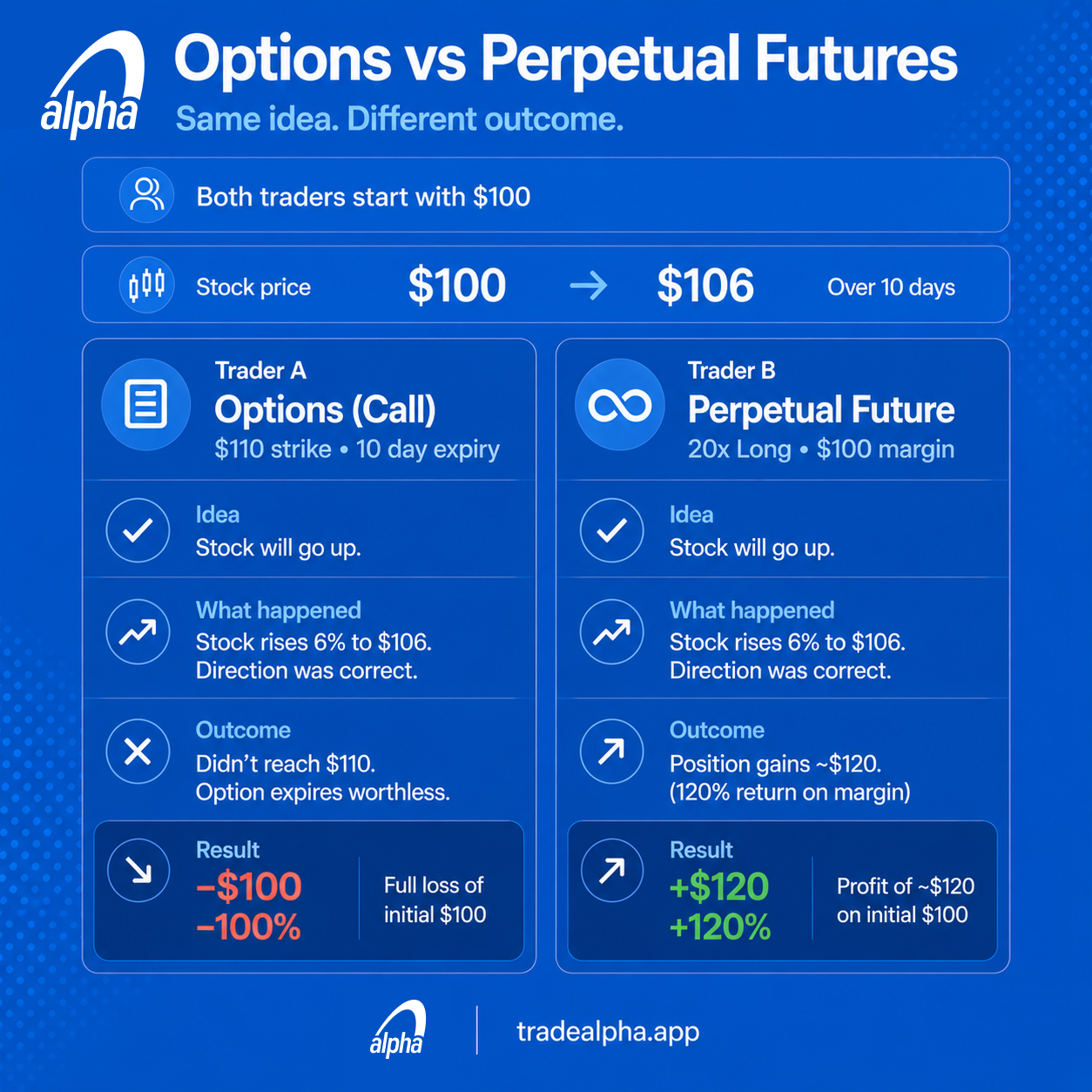
Two traders both believe Stock A, currently at $100, will go up.
Trader A uses options. He puts $100 into a call option with a $110 strike price, expiring in 10 days. Over the next 10 days, the stock rises 6% to $106. The direction was correct. But the stock didn't reach $110 so the option expires worthless. Trader A loses their full $100.
Trader B uses a perpetual future. He opens a 20x long position with $100 of margin, controlling $2,000 of exposure. The same stock makes the same 6% move. The position gains roughly $120, an 120% return on his initial balance. He had a single decision to get right, and he got it!
Key terms
Premium (options)
The up-front cost paid by an options buyer; it represents the buyer's maximum loss and consists of intrinsic value plus time-value.
Strike price
The price at which an option holder has the right to buy (call) or sell (put) the underlying stock; an option only has intrinsic value when the underlying stock price is past the strike in the buyer's favor.
Theta (time decay)
The daily erosion of an option's time-value as expiration approaches; an at-the-money option loses a small amount of value each day, all else equal.
Implied volatility (IV)
The market's forward-looking estimate of a stock's price variability, embedded in option prices; higher implied volatility makes options more expensive and increases the move needed for a long-option position to break even.
Perpetual futures contract (perp)
A derivative contract that lets a trader take a leveraged position on the price of an underlying stock with no expiration date; positions are kept in line with the underlying stock price via periodic funding payments between longs and shorts.
Funding rate
A small periodic fee exchanged between longs and shorts on a perpetual futures contract; when the perp trades above the underlying stock's spot price, longs pay shorts, and vice versa. Funding keeps the contract price tied to the underlying stock price.
Liquidation
Automatic closure of a leveraged position by the platform's risk engine when the trader's margin falls below the maintenance threshold; on retail venues with liquidation engines, this caps losses at the posted margin.
Direct leverage
Exposure that scales linearly with the underlying stock price — typically expressed as a multiple (e.g., 5x), where a 1% move in the stock produces a 5% move in the leveraged position.
Bottom line
Options are designed for trades with a thesis about direction, price, and timing — managed across three variables. Perpetual futures are designed for traders with one strong opinion: direction. Both offer leveraged exposure. Perpetual futures offer a simplified path to it, without the additional complexity.
Over the last few years, mobile trading platforms made options accessible to millions of retail traders for the first time. Perpetual futures on stocks are the next step — the same leverage, but built around a simpler trade.
Disclaimer
Not Financial Advice. This content is for informational purposes only and is not financial or investment advice. Please consult a qualified financial professional before making any trading or investment decisions.
Nature of Services. Alpha is a non-custodial software interface only and is not a trading venue, broker, dealer, intermediary, or investment adviser. Alpha does not execute or handle trades, custody assets, or hold user funds. All transactions are executed and settled directly between users and third-party protocols (such as Orderly), subject to their terms and applicable restrictions. Use at your own risk.
Risk Warning. Trading involves significant risk of loss, including the potential loss of your entire investment. Do not trade with money you cannot afford to lose.
No Invitation to Trade. Nothing in this content constitutes an invitation to trade, an inducement to engage in any investment activity, or a recommendation to enter into any trade or transaction. This content should not be relied upon in connection with any trading or investment decision.
Jurisdiction. Alpha's services are not available to persons located in, resident in, or citizens of the United States, and no US person may participate in Alpha's platform, waitlist, or any associated rewards program. This communication is not directed at residents of the United Kingdom pursuant to the FCA's financial promotion rules for cryptoassets, or to residents of the United States. This content does not constitute an offer or solicitation to any person in the United States, the United Kingdom, or in any jurisdiction where such offer or solicitation would be unlawful. Alpha's services may not be available in all other jurisdictions. It is your sole responsibility to ensure compliance with all applicable laws and regulations in your jurisdiction before accessing or using Alpha's services.
Not Financial Advice. This content is for informational purposes only and is not financial or investment advice. Please consult a qualified financial professional before making any trading or investment decisions.
Nature of Services. Alpha is a non-custodial software interface only and is not a trading venue, broker, dealer, intermediary, or investment adviser. Alpha does not execute or handle trades, custody assets, or hold user funds. All transactions are executed and settled directly between users and third-party protocols (such as Hyperliquid), subject to their terms and applicable restrictions. Use at your own risk.
Risk Warning. Trading involves significant risk of loss, including the potential loss of your entire investment. Do not trade with money you cannot afford to lose.
No Invitation to Trade. Nothing in this content constitutes an invitation to trade, an inducement to engage in any investment activity, or a recommendation to enter into any trade or transaction. This content should not be relied upon in connection with any trading or investment decision.
Jurisdiction. Alpha's services are not available to persons located in, resident in, or citizens of the United States, and no US person may participate in Alpha's platform, waitlist, or any associated rewards program. This communication is not directed at residents of the United Kingdom pursuant to the FCA's financial promotion rules for cryptoassets, or to residents of the United States. This content does not constitute an offer or solicitation to any person in the United States, the United Kingdom, or in any jurisdiction where such offer or solicitation would be unlawful. Alpha's services may not be available in all other jurisdictions. It is your sole responsibility to ensure compliance with all applicable laws and regulations in your jurisdiction before accessing or using Alpha's services.